

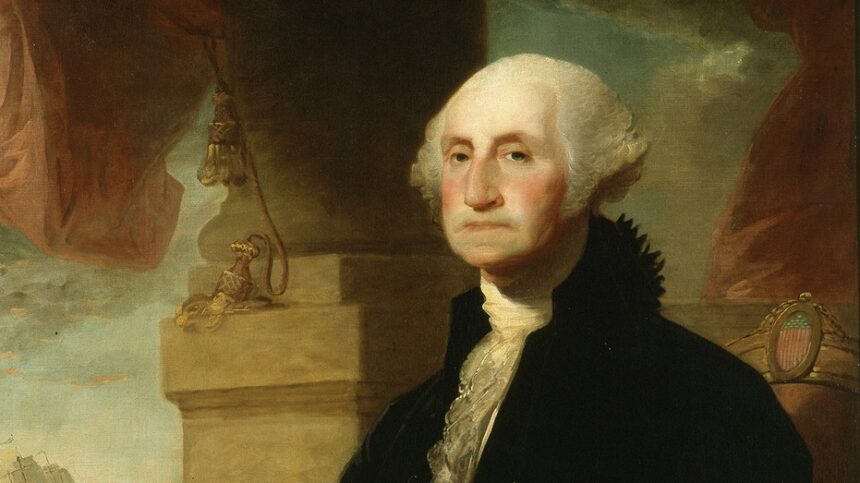
In August of 1776, the Revolution in America was almost snuffed out. Earlier that year, 44-year-old George Washington had marched 19,000 ragtag soldiers to Manhattan after forcing a British evacuation of in the months before the declaration. In July, the British launched an attack on the colonies with the full weight of the most powerful military in the world. British General William Howe arrived at Staten Island with 400 ships and 32,000 well-trained men.
Washington was outflanked, outgunned and outmaneuvered. On the eve of the Battle of Brooklyn in late August, Washington rallied the troops saying:
The fate of unborn millions will now depend, under God, on the courage and conduct of this army. Our cruel and unrelenting enemy leaves us only the choice of brave resistance, or the most abject submission. We have, therefore, to resolve to conquer or die.
Die, they did. After a brutal assault from Howes troops, Washingtons soldiers were forced to execute a panicked retreat into Brooklyn Heights. With their backs pinned against the East River, they were only spared by an act of God, a dense fog, that allowed Washington to escape with 9,000 troops across the river to Manhattan.
They survived, but over the course of the fall, the new army was defeated in White Plains and Manhattan, forcing a retreat to and leading to British occupation of New York for the remainder of the war. Morale collapsed. Enlistments expired. Soldiers deserted. The future looked grim.
As we celebrate 250 years of American identity, its easy to forget how rocky that path has been. The lasted six years of active fighting (eight before a formal treaty), with the British on the brink of victory for much of that time. Emerging from the end of the war, the American movement faltered. Our first stab at governance, the Articles of Confederation, was calamitous â leading to a new Constitutional Convention in 1787. Despite electing Washington as president unanimously, the founders fragmented into ruthless factions that threatened to tear the new nation apart.
The British waged war again in 1812, occupying Washington, D.C., and burning the in 1814. Slavery, our nations greatest failure, persisted for nearly a century, and ended only when a terrible Civil War claimed the lives of some 600,000 to 800,000 Americans. Women were not granted the right to vote until 1920, nearly 150 years after Jefferson had declared all men free. And the late 1800s and early 1900s were plagued by ethnic strife, anarchist movements, assassinations and rising communism that imperiled the fledgling republic at every turn.
But one nation, under God, endured. Washington led the new republic honorably as president then peaceful transition. Patriots fought the British to a stalemate in the War of 1812, and the new nation moved forward. The Founders and their successors conducted fierce political fights but found ways to work together and prove the efficacy of a democratic system.
President Abraham Lincoln reunified the republic, then his successors extended grace to those defeated so that we could move forward together. Opposing ethnic groups assimilated, e pluribus unum. Anarchism and communism retreated. And when the broader world was imperiled, we dispatched millions of brave Americans overseas to fight the evils of fascism beyond our shores. We resisted colonialism and financed the rebirth of enemies and allies alike. We grew the greatest entrepreneurial economy in . We marched toward equal rights and opportunity for all.
And despite our flaws, on the eve of our 250th birthday, America still stands as a around the world, and home to the most prosperous, diverse and innovative people in history.
Whats next? Its tempting to be pessimistic. We see our problems. Politics and culture are divided. A suffocating national debt. Ideological enemies overseas who care little for human freedom. A people who sometimes seem to have forg


