The U.S. is clawing back oil sanctions waivers offered to Iran as part of a framework deal that kicked off a two-month negotiating period after Iran attacked commercial vessels in the Strait of Hormuz Monday and Tuesday.Â
A U.S. official confirmed that three commercial vessels were struck by Iran in the Strait of Hormuz between Monday and Tuesday, reigniting tensions after President said the U.S. had given Tehran “a week off” during funeral ceremonies for slain Supreme Leader Ali Khamenei.
“As President Trump and the administration have repeatedly affirmed, the MOU in effect with Iran is entirely performance-based. Iran will only reap benefits if they exhibit good behavior,” a U.S. official said, confirming the Treasury Department’s Office of Foreign Assets Control (OFAC) would revoke the sanctions waivers.Â
“Irans actions in the Strait were wholly unacceptable to the United States and will be met with consequences. Our negotiators continue to work in good faith towards a final deal,” the official continued.Â
The sanctions relief was part of a memorandum of understanding signed in June that launched a 60-day negotiating period between Washington and Tehran. Under the framework, both sides agreed to halt military operations while pursuing a broader peace agreement, and Iran committed to reopening the Strait of Hormuz to commercial shipping in exchange for limited economic relief, including oil sanctions waivers.
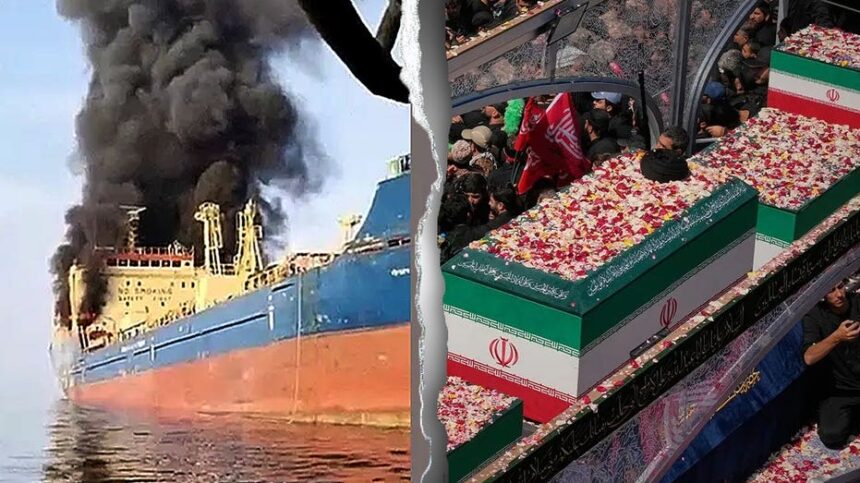
The attacks targeted commercial shipping transiting one of the world’s busiest maritime choke points. British maritime authorities confirmed a vessel was struck by a projectile near the coast of Oman Monday, while Iranian state media reported the ship had ignored warnings from Iranian forces. The attack reportedly caused a fire on board, but there were no immediate reports of fatalities.
On Tuesday, the U.K. Maritime Trade Operations (UKMTO) reported that another tanker transiting the Strait of Hormuz had been struck by an unidentified projectile. UKMTO said the vessel sustained what was believed to be structural damage but reported no casualties or environmental impact. The agency said it was continuing to investigate the incident and advised vessels transiting the strait to exercise caution and report any suspicious activity.
WALTZ CALLS OUT IRANIAN DIPLOMAT AT UN FOLLOWING DRONE STRIKES ON BAHRAIN AND KUWAIT
The attacks threaten one of the world’s most important energy corridors and have already prompted the Trump administration to revoke a key concession offered to Iran under a ceasefire agreement, raising fresh questions about whether the fragile truce can survive long enough for the two sides to negotiate a broader peace deal. Roughly one-fifth of the world’s seaborne oil passes through the Strait of Hormuz, making disruptions to commercial shipping a potential risk to global energy markets and U.S. strategic interests.
That followed two ships being hit Monday.
A U.S. official confirmed one ship hit Monday as the Al Rekayyat, a Qatari liquified natural gas carrier. Iran acknowledged the attack, with state media saying the tanker ignored “repeated warnings” and continued to transit along the southern route of the strait near Oman with U.S. assistance.
A second vessel, the Saudi-flagged crude tanker Wedyan, also sustained damage near the Strait of Hormuz, a U.S. official confirmed. The cause of the damage was not immediately clear, and Fox News Digital has reached out to the vessel’s operator, Bahri, and the Saudi Embassy in Washington for comment.
The White House and the Pentagon did not respond to a