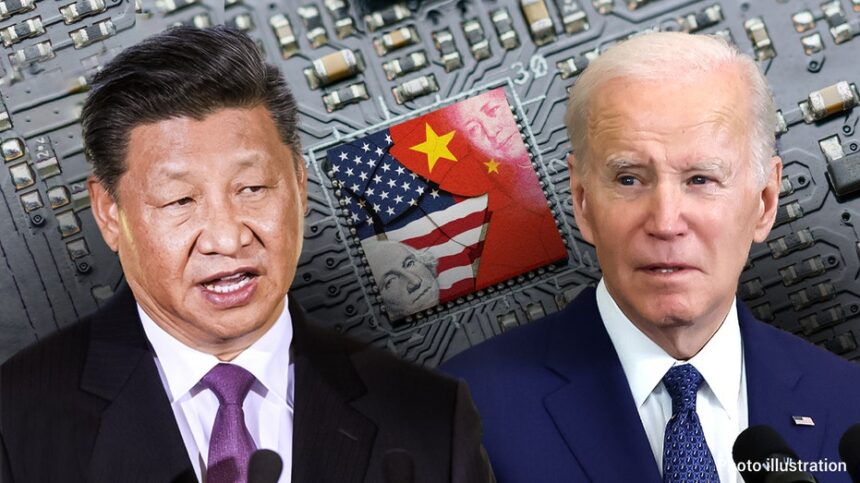
Despite American export controls designed to cut Huawei off from the world’s most advanced semiconductor technology, China’s largest technology company is poised to post a 60% jump in chip revenue this year â a far cry from the death blow the Biden administration had hoped the restrictions would deliver.
Following export controls implemented in 2023, China directed its state agencies to purchase hardware, chips, mobile devices and software from Huawei while also pouring over $1 billion in government grants into the company.
Now, three years later, Huawei is expected to close 2026 with about $12 billion in chip revenue â a massive jump from $7.5 billion in 2025, according to analysts.
The result is fueling debate over whether U.S. export controls have inadvertently made Huawei strongerâor whether they have successfully slowed China’s push to compete in advanced semiconductors.
STEPHEN MOORE: GOVERNMENT CONTROL OF CHIP SALES HAS A SHOCKING DOWNSIDE
To some, like Jensen Huang, CEO of Nvidia, the worlds largest semiconductor engineering company, theres reason to still believe Huawei should merit respect.
“Huawei is the single most formidable technology company in China,” Huang told the Financial Times earlier this year.
“Theyve conquered every market theyve engaged in,” he added.
The U.S. originally placed restrictions on Huawei in 2019, blacklisting its devices from government use.
The Biden administration continued to tighten restrictions in the next few years.
In 2022, it banned sales and imports from the company and, a few months later, halted export licenses to Huawei entirely, citing national security interests. In 2024, the U.S. pressed for many of its allies to follow suit. The Trump administration has continued those efforts in 2025, blocking dozens of Chinese groups from accessing semiconductors and other pieces of technology.
The compounding moves created a de facto ban on the company.
“The export controls announced in the two rules today restrict the PRCs ability to obtain advanced computing chips, develop and maintain supercomputers, and manufacture advanced semiconductors,” the U.S. Department of Commerce wrote in a statement at the time.
“These items and capabilities are used by the [Peoples Republic of China] to produce advanced military systems including weapons of mass destruction; improve the speed and accuracy of its military decision-making, planning, and logistics, as well as of its autonomous military systems; and commit human rights abuses.”
But by then, China had already begun laying the groundwork for using Huawei as a way to step away from reliance on the U.S.
CHINA IS BUILDING AN AI WAR MACHINE. WASHINGTON MUST WAKE UP BEFORE ITS TOO LATE
Huaweis annual reports indicate that the companys government grants skyrocketed during the same period. From 2.5 billion yuan in 2021, worth roughly $403 million, the company receive