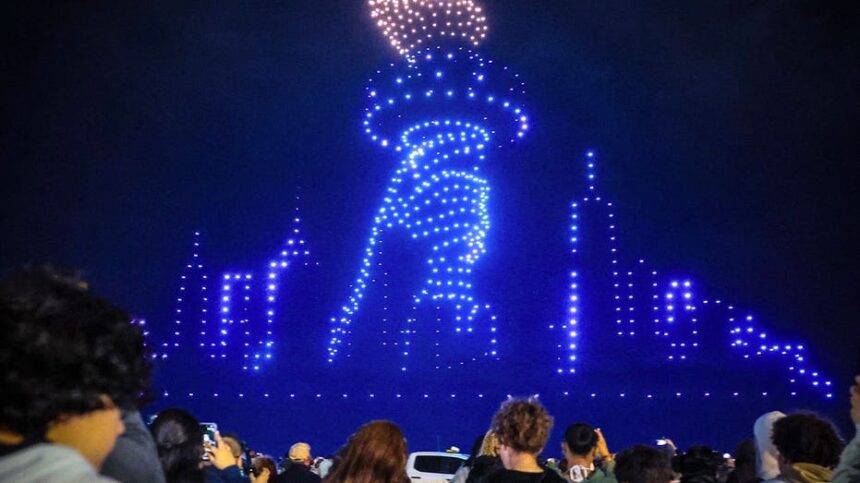
Drone shows are rapidly replacing fireworks at concerts, sporting events and Fourth of July celebrations as communities embrace what many see as a safer, more environmentally friendly alternative. However, as the skies become more crowded with drones, security experts say the increasingly crowded airspace around large public events can make it more difficult to detect potentially bad actors.
R2 Wireless CEO of U.S. Operations Cordell Bennigson, who is a retired Marine Corps officer, told Fox News Digital that the growing prevalence of drone shows demonstrates how accessible the technology has become, creating new challenges for event security and public safety.
Bennigson said that he personally enjoys drone shows and finds them to be “impressive,” but said the displays highlight a growing security challenge that extends well beyond the shows themselves.
BROOKLYN BRIDGE CATCHES FIRE AMID NYC FIREWORKS DISPLAY AS TRUMP HAILS IT IN DC SPEECH
“A drone show itself isn’t a security risk, but it’s an indication of how accessible drones are,” he said. “The other piece of the puzzle is what happens in the clutter and the noise of the full RF spectrum, all the wireless transmissions that are out there.”
The radio frequency (RF) spectrum is made up of the invisible wireless signals used by everything from cellphones to drones. These airwaves can become busy during drone shows, due to the tech involved in the show and the spectators taking videos on their phone. According to Bennigson, the additional wireless traffic can make it more difficult for security officials to identify an unauthorized drone flying near an event, allowing it to blend in with legitimate electronic activity.
“Detection is the first line of defense,” Bennigson said. “Obviously, we want to be able to defend against a drone from a bad actor, but we have to be able to detect it, and we have to be able to see through all of that clutter, all of the noise in the electromagnetic spectrum, in order to do that.”
While some might think reducing wireless transmissions could be a solution, Bennigson said the idea is “unrealistic.” In fact, he believes the technology will only become more prevalent, making it even harder to mitigate noise on the RF spectrum. Instead, Bennigson said that experts need to focus on refining detection capabilities.
“The question has to become, how do we get better at seeing or detecting within the noise, within the clutter?” he said.
Bennigson compared the approach to the use of night vision goggles.
“People with bad intentions used to be able to hide in the dark, and then we didn’t get rid of the dark in order to mitigate that. We got better at seeing in the dark in order to mitigate it. And then it turned out actually we could use that capability for other kinds of things as well. So, we have to get better at seeing in the electromagnetic spectrum, which is what our focus is at R2, being able to do exactly that,” Bennigson told Fox News Digital.
FOURTH OF JULY APP GUIDES SPECTATORS THROUGH NINE-HOUR AIR SHOW FROM NASA JETS TO B-1 BOMBERS
Bennigson said artificial intelligence is becoming an increasingly important tool in detecting potential bad actors. He noted that the technology is able to rapidly sift through enormous amounts of