

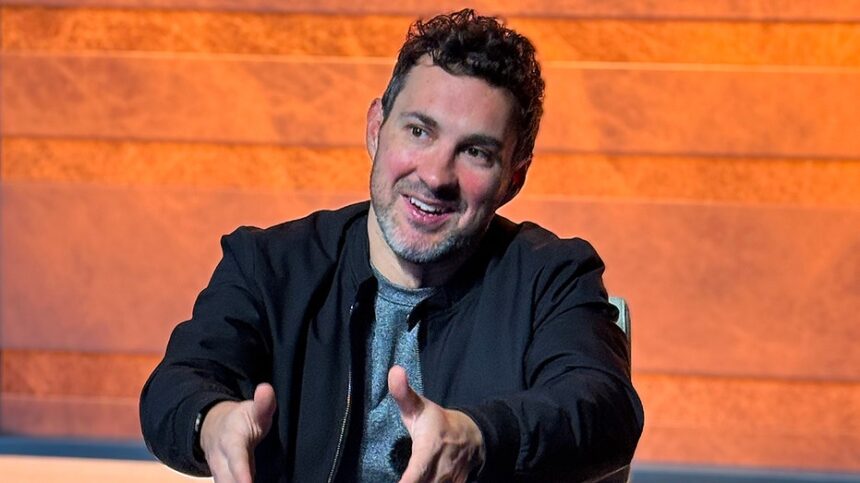
Stand-up comedian Mark Normand talks the way he performs: fast, loose and irreverent, with a punchline lurking around every corner.Â
With a baby at home and a new Netflix special on the way, Normand sat down with Fox News Digital to discuss writing comedy in an increasingly tribal culture, where jokes are often judged less by whether they land than by the politics of the person telling them â and where has lost its edge to polished predictability.
The New Orleans-born comic’s newest Netflix special, “None Too Pleased,” which premieres March 17, is a rapid-fire, “joke-every-30-seconds” type of show, Normand said. In it, he pokes fun at the partisanship and lack of nuance he sees in public discourse.
Normand said what bothers him about comedy today more than a particular political slant is the presence of any finger-wagging in the first place. The monologue-based, one-way communication of stand-up comedy makes the medium uniquely suited to be hijacked and turned into a lecture.
“Imagine if a musician just came up, put his guitar down and was like, ‘Let me tell you about Iran and Israel.’ And you’re like, ‘Well, what about the music?’ [Stand-up comedy] is the only art form that’s so subjective that you can kind of slip away from the comedy part because you’re holding a microphone and have a stool with a beer on it,” he said.
Normand said comedy has become “weirdly morality-based,” and the craft that once rewarded nerve is now more frequently filtered through a lens of sensitivity.
“When I was a kid, you watched Blazing Saddles or or whatever, and it was just like, the worst things are what you should lean in on.”
However, he clarified that shock for its own sake is no closer to comedy. Normand insisted that the issue is not whether subjects are sensitive, but whether comics have done the work to transform them into jokes rather than slogans or cheap shots.
“I think some people do that horribly, and they just say a word without having a joke. I think as long as it’s always a joke, you can talk about anything. Everything is on the table, and I think making horrible things funny is part of the job. So I say lean in, but it’s gotta be funny. That’s the key. It’s got to be a laugh.”
“And that’s the art form,” he said, “making it funny and getting away with it.”
Too often, audiences are more focused on trying to discern a speaker’s political position than on listening for the punchline, Normand said, arguing that people only want to listen to those on “their side.”
This social media algorithm-fueled partisanship is “ruining everything” and preventing the exchange of ideas, he continued.
“People are seeing two completely different realities. So I can tell people are sitting in the audience like, ‘What is he? What is he? Is he right? Is he left? What’s going on here? I can’t laugh because I don’t know where he’s at,’ and I think that’s .”
“When I was a teenager, they would go, ‘Straight or gay?’ But now it’s, ‘Right or left?’ and I like to keep them both in the dark.”
Stand-ups face an additional hurdle. By the nature of the craft, they have to work out their material in front of an audience, unlike other artists or athletes who can practice outside the arena. This means it might take a few rounds of workshopping before a joke really lands, which is especially perilous for one’s reputation when fine-tuning a potentially offensive joke.
To reassure his audience that he’s on their side, Normand issues a disclaimer between bits at the start of his special: “I should warn you guys, I will say some horrific s— up here, but it’s all jokes, just fun.“
“We’ve kind of got this Pavlovian response now to certain topics, like race or gay or men, whatever it is,” Normand told , saying people can get triggered by the very mention of a subject before it’s even clear where a joke is headed.
“So I wish people would just listen. And


