

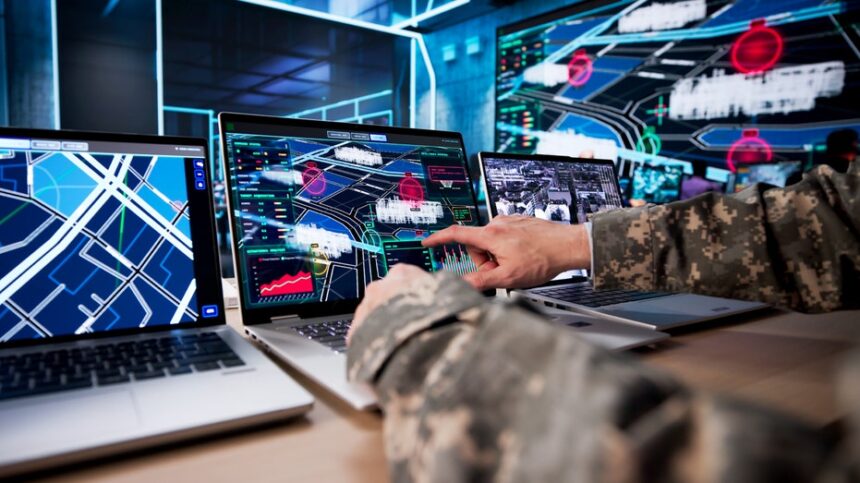
For years, Silicon Valley operated as if war was someone elses problem. Operation Epic Fury proved otherwise. The U.S.-Israeli campaign against Iran, launched Feb. 28, pulled American technology companies to the center of active warfare â not as distant suppliers, but as participants and now deliberate targets. In my forthcoming book, “The New AI Cold War,” I warned this moment was coming. Iran made it real.
CENTCOM Commander Admiral Brad Cooper said it plainly in a March 11 video update: help U.S. forces sift through vast data in seconds so commanders make decisions faster than the enemy can react. Tasks that once took days now take seconds. Humans still approve the final targets. However, the machine does the analysis.
At the heart of that process is Palantirs Maven Smart System, running on Anthropics Claude. NBC News confirmed that Palantirs AI identified potential targets in . The Washington Post reported AI enabled U.S. forces to hit 1,000 targets in the first 24 hours.
Retired Admiral Mark Montgomery told CBS News the military now processes roughly a thousand targets a day with turnaround under four hours â a pace no previous campaign has matched. Palantir CEO Alex Karp confirmed on CNBC that Claude is still running inside the targeting system despite the supply chain designation.
As I document in “The New AI Cold War,” that shift is now baked into doctrine. The classic Observe-Orient-Decide-Act loop has shrunk to two steps: machines observe and decide; commanders orient and act. Strip away the jargon and the meaning is plain â the machine is now doing the thinking.
Operation Epic Fury did not emerge from a vacuum. Ukraine was the laboratory. As “The New AI Cold War” documents, of Palantirs MetaConstellation â drawing on Starlink satellites, weather data and civilian smartphone uploads â compressed Kyivs entire operations cycle to machine speed, helping offset Russias numerical advantage.
Ukraine retrained publicly available AI models on frontline combat data and deployed them across its drone fleet, boosting strike accuracy from 10â20% to 70â80%. Drones now account for 70â80 percent of battlefield casualties in Ukraine, with AI targeting added to platforms for as little as $25 per unit.
Russia absorbed those lessons and passed them to Tehran. The Kremlin supplied Iran with Shahed-136 drones upgraded with AI navigation that defeats GPS jamming â technology first tested against Ukraine. And China supplies roughly 80% of the critical technologies inside Russian drones. That coalition has been slow to register in Washington. It should not be.
Iran drew the logical conclusion: if American military power flows through servers, destroy the servers. The IRGC-affiliated Tasnim News Agency published a target list naming Amazon, Microsoft, Google, Nvidia, IBM, Oracle and Palantir â 29 locations across the UAE, Israel, Qatar and Bahrain â captioned “.”
This was not rhetoric. had already hit two AWS data centers in the UAE and a third in Bahrain before the list appeared. AWS confirmed structural damage, disrupted power, and fire suppression at its facilities. Nvidias stock fell roughly 9% in two days. Wall Street finally caught up to what every strategist already knew: U.S. military power runs through servers as surely as it runs through F-35s.
Consider the threat receiving almost no attention â and carrying the greatest economic consequence for Americans at home. AI runs on semiconductors. Semiconductors require helium â non-substitutable under current manufacturing processes. Qatar produces a third of the worlds helium at its Ras Laffan Industrial City. On March 2, Iranian drone strikes forced QatarEnergy to halt all production. Force majeure followed two days later. Subsequent strikes inflicted what QatarGas called “extensive” damage â annual helium exports cut 14%,


