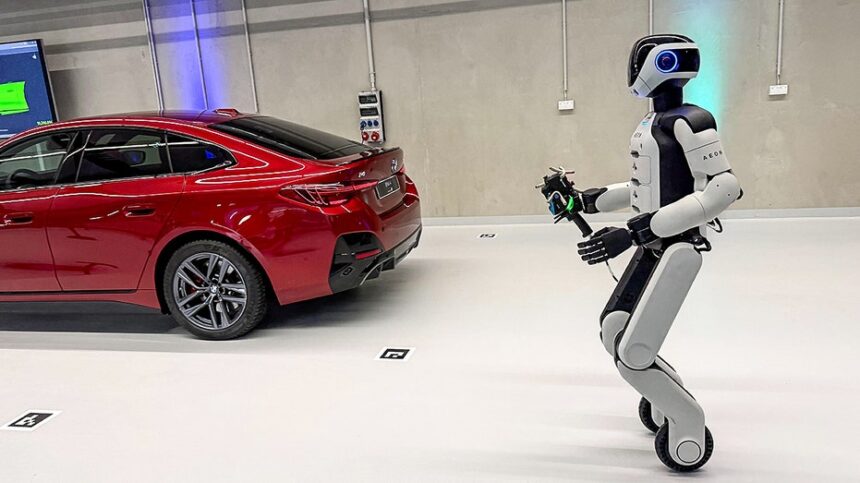
BMW Group has spent years but this latest move feels different. Instead of robotic arms locked in cages, the company is now using humanoid robots that move through factories more like people. After a successful pilot in Spartanburg, South Carolina, BMW is bringing that same idea into its Leipzig, Germany, factory, where it is testing robots in real production environments. This time, it is partnering with Hexagon Robotics to introduce a new generation of AI-powered machines. Unlike many robot demos you see online, this one is already being tested inside a real production environment.
Sign up for my FREE CyberGuy Report
Plus, you’ll get instant access to my Ultimate Scam Survival Guide free when you join.
BMW’s earlier pilot used for a very specific task. They handled the precise positioning of sheet metal for welding on the BMW X3 production line. That task may seem small, but it plays a key role in keeping production moving smoothly. Precision work like this can easily slow things down or create bottlenecks. According to BMW, those robots helped contribute to building more than 30,000 vehicles. Because of that success, the company now feels confident about expanding the concept. Instead of limiting testing to one plant, BMW is moving forward with its iFACTORY initiative in Leipzig, where EV production is already a major focus.
The new robots, called AEON, come from Hexagon Robotics. They are designed to work inside active factory environments without constant human direction. They rely on AI-based motion control, which helps them move through complex spaces. At the same time, built-in sensors allow them to understand their surroundings in real time. Because of that, they can adjust their actions on the fly instead of following fixed instructions. Hexagon refers to this as “Physical AI.” In simple terms, the robot can make decisions based on what it sees around it. As a result, the robot does not stop when something unexpected happens. Instead, it adapts and keeps working. That marks a clear shift from traditional factory automation.
BMW executives have made it clear that this is not about replacing people overnight. Instead, the goal is to test what actually works in real production environments. Michael Nikolaides, who oversees network, says these pilot programs help the company refine how AI-powered robots learn on the job. He goes on to point to a broader vision, saying: “Digitalization improves the competitiveness of our production, here in Europe and worldwide. The symbiosis of engineering expertise and artificial intelligence opens up entirely new possibilities in production.” There is also a practical reason for the humanoid design. Factories are already built for human workers. Because of that, a robot that can use the same spaces and tools is much easier to integrate than one that requires a complete redesign.
For years, humanoid robots felt more like something you saw in those social media demo videos than something you would trust on a real factory floor. Yes, they looked impressive, but they struggled in real environments. That is starting to change. Factories are still unpredictable. Parts do not always arrive in the exact same position. Workers move around constantly, and tools and materials shift throughout the day. Because of this, traditional robots often struggle since they rely on tightly controlled conditions. AI-powered humanoid robots can handle that kind of variability. They move around people and equipment without stopping. They adjust when parts are slightly off, and they work in spaces built for human workers. That level of flexibility is what sets this new wave of AI-powered robotics apart from earlier forms of automation.
Even if you never step inside a factory, this shift still matters. For one, it could change how cars are built, whether they are electric or gas. When production speeds up, costs can come down over time, whi