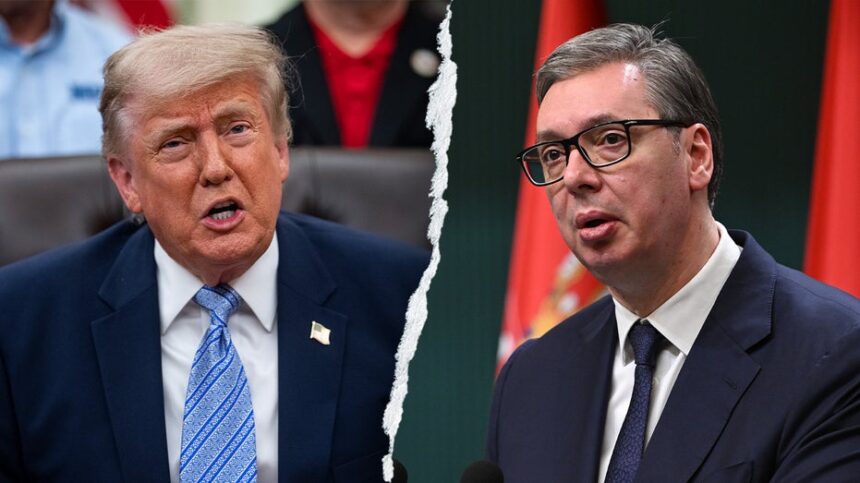
Serbian President Aleksandar VuÄiÄ says relations between Serbia and the United States have undergone a dramatic transformation under President , a shift he says has changed public perceptions in a country where memories of the 1999 NATO bombing campaign remain deeply rooted.
In an exclusive interview with Fox News Digital, VuÄiÄ praised Trump’s approach to , arguing that the administration’s focus on economic cooperation rather than political pressure resonated with many Serbs. “President Trump and his team so far were working very diligently and dedicatedly on the Western Balkans,” VuÄiÄ said, adding that many Serbs view his administration very differently from previous U.S. governments.
“If you ask people in Serbia just to make a comparison between Clinton and Trump’s administration, or Democrats to , you wouldn’t believe it,” VuÄiÄ said. “It would be 90 to 10 or 95 to 5.”
The comparison is particularly striking in Serbia, where many still associate the United States with during the Kosovo conflict, launched to stop Serbian forces’ crackdown on ethnic Albanians in Kosovo and which remains one of the most consequential events in modern Serbian history.
VuÄiÄ said he recently extended an invitation to Trump to visit Serbia and predicted the American president would receive an enthusiastic welcome.
“I hope that we’ll be able to host him,” VuÄiÄ said. “More people will be ready to greet him and wait for him than he might even expectâ¦I dare to say even more than hundreds of thousands of people.”
The Serbian president said the improving relationship between Washington and Belgrade is increasingly centered on economics, and technological cooperation, and mutual conservative values.
According to VuÄiÄ, Serbia and the United States are preparing to launch a strategic dialogue that will focus on energy, infrastructure, , defense cooperation and investment opportunities. Among the projects under discussion are , liquefied natural gas cooperation, data centers and advanced computing technologies.
The growing relationship comes as Serbia seeks to position itself as a regional economic hub while continuing its long-standing ambition of joining the .
VuÄiÄ pointed to preparations for Expo 2027 in Belgrade with nearly 150 participating countries, as evidence of Serbia’s growing international profile and economic ambitions.
VuÄiÄ, who has served as since becoming prime minister in 2014 and president in 2017, pointed to the country’s economic growth as evidence of its transformation. “Our GDP was 32 billion (euros) when I became the prime minister,” VuÄiÄ said. “This year it’s going to be over 100 billion euros., which is $120 billion.”
VuÄiÄ’s relationship with Trump dates back to the president’s first term, when the White House brokered a series of economic normalization agreements between Serbia and Kosovo. Rather than focusing first on the politically explosive question of Kosovo’s status, the Trump administration emphasized infrastructure projects, transportation links and investment aimed at improving ties between the two sides.
In September 2020, VuÄiÄ and then-Kosovo Prime Minister Avdullah Hoti signed U.S.-brokered economic agreements at the White House that included commitments to expand rail and highway connections and promote investment. Trump described the deal as a breakthrough achieved by focusing on “job creation and economic growth” rather than longstanding political disputes.
Asked whether he would consider recognizing Kosovo, which in 2008 and has been recognized by the United States under President George W. Bush and most European countries, if doing so unlocked Serbia’s economic future and accelerated its path toward membership in the European Union, VuÄiÄ pushed back on the premise, arguing that economic cooperation and improved relations should come before discussions about political status.
“I’m not saying that I’m ready