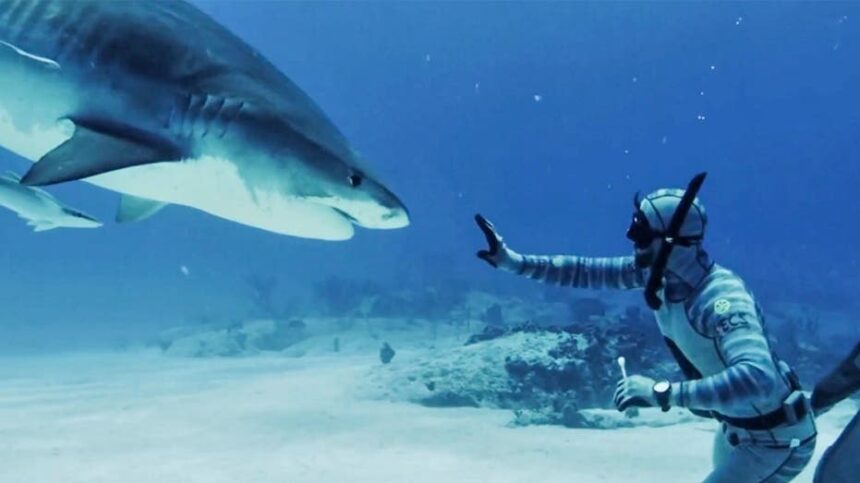
Shark attacks and sightings are once again making headlines across the United States. And with summer in full swing, it can feel like every other day brings another report of a shark encounter somewhere along the coast.
But are there actually ? Are more people being attacked? Or are we all just paying closer attention?
According to wildlife biologist, TV personality and Shark Week host Forrest Galante, the answer is D) all of the above.
“It’s a little bit of everything,” Galante told OutKick Outdoors. “Shark populations in a lot of places, like California and Florida, have rebounded because historically, 20, 30, 40, 50 years ago, we had overfished a lot of that area, and the sharks had moved out. So with good conservation efforts, the predators are coming back.”
In other words, seeing more sharks in some areas is not necessarily a sign that something has gone wrong. It may be the opposite, actually. But at the same time, there are also more people in the water, more cameras capturing every encounter and more media attention any time something happens.
“We have cell phones, so the media around it is happening,” Galante said. “Summertime is when sharks like to hunt coastally and come close to the beaches, which is of course where and when we’re swimming. So when you put all these factors together, that’s why we see this spike in shark bites every single summer.”
Watch Forrest Galante’s full interview with OutKick Outdoors here:
According to the Florida Museum of Natural Historys International Shark Attack File, researchers confirmed 65 unprovoked shark bites worldwide in 2025, slightly below the 10-year average of 72. Nine of those bites were fatal. The United States recorded 25 unprovoked bites, the most of any country, with Florida leading the nation at 11 reported incidents.
No surprise there, given how much time Floridians spend in the water.
That said, the numbers dont suggest sharks are suddenly hunting people in record numbers. In fact, the Florida Museum noted that U.S. shark bite numbers have decreased overall during the past five years. Thats despite more sharks in U.S. waters.
The recent headlines, however, have been hard to miss.
In early June, a Navy base employee was critically injured by a suspected bull shark while swimming near a marina in Panama City, Fla. Just days earlier, a child swimming in knee-deep water at WaterColor, Fla., suffered wounds to the leg, prompting a 5-mile double-red-flag beach closure.
And outside the U.S., a 38-year-old man was killed in May after being bitten by a large great white shark while swimming at Rottnest Island off the coast of Western Australia. In mid-June, a 34-year-old school teacher was also critically injured while swimming at a heavily patrolled beach in Sydney.
TrackingSharks.com, a privately run shark-safety and journalism site, had recorded 30 shark attack bites worldwide in 2026 as of July 5 â including seven fatal incidents.
Still, this doesnt mean we all need to run terrified from the beaches this summer. Galante stressed that most shark-human interactions do not end badly.
“It’s nothing to do with the sharks wanting to eat us,” he said. “It’s everything to do with this perfect confluence of situations that lead to more interactions in general, and it’s a fraction of a percent of those interactions that end up being negative. That is what we’re all talking about.”
That may be the part that gets lost in the panic. Sharks are predators, yes. The ocean comes with risk, obviously. But humans are not generally on the menu.
“They say that som