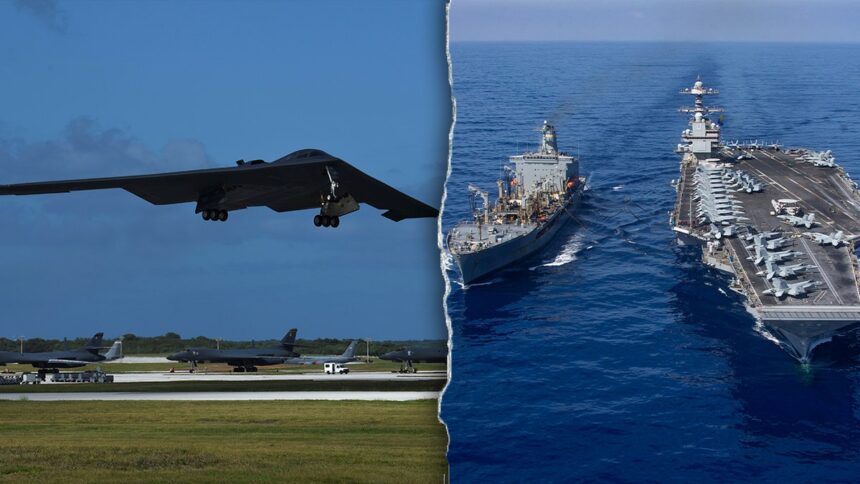
At Camp David, President Donald Trump signaled that Washington is entering a more dangerous phase in its confrontation with Iran. The objective is seemingly no longer limited to dismantling Irans nuclear infrastructure; it is now to weaken the Islamic Republics ability to govern, sustain itself, and ultimately survive.
Americas strategy toward Iran is undergoing its most significant shift in decades. The objective is apparently no longer simply to destroy Tehrans nuclear program, but to systematically degrade the regimes capacity to govern and sustain itself. At Camp David, President Donald Trump said the United States is prepared to intensify military pressure, warning that Washington would “hit them very hard” until the regime reaches a point where it “cant go on anymore.”
Trumps repeated cancellations of planned large-scale strikes have raised questions about U.S. credibility and strategic coherence. Meanwhile, Tehran â backed by Moscow and Beijing â is exploiting that uncertainty, while Trump appears to be placing his hopes on a faction within Irans Supreme National Security Council.
IRANIANS SPEAK OUT OVER POSSIBLE TRUMP-REGIME DEAL
Many Iranians would welcome the ruling establishments humiliation, defeat, and eventual surrender. Although disrupting the regimes critical infrastructure would impose temporary hardships, many opponents of the Islamic Republic see such suffering as the pain of childbirth â a difficult but necessary transition that could ultimately bring about the regimes collapse.
Meanwhile, Tehrans propaganda machine has threatened broad retaliation, warning that attacks on critical infrastructure will provoke a severe response. These statements indirectly acknowledge the regimes preparation for a wider confrontation with the United States and Israel. They also raise the possibility that Tehran could activate dormant terrorist cells and other asymmetric assets in the United States and across the West â an arena in which the Islamic Republic has decades of experience.
The Iranian people are entering an even deeper period of hardship as the regime steadily loses control over large parts of the country. It could spiral into chaos at any moment. If, after the regime’s collapse, a figure such as Crown Prince Reza Pahlavi does not lead a transitional government, Iran could face a bloodbath. The remnants of the Islamic Republic are likely to regroup through mosques and underground terrorist networks, preserving their ideology and continuing their campaign by other means. This risk cannot be ignored.
The current White House has shown no serious commitment to regime change in Iran. Defeating Islamist terrorism requires political resolve, strategic clarity, and a clear understanding of the threat. More than two decades into the 21st century, Washington has failed to defeat a regime that continues to serve the strategic interests of Moscow and Beijing, while much of Europe remains detached from reality. Israel alone has recognized that its security â and the emergence of a new Middle East â depends on regime change in Iran.
<a href="https://foxnews.com/opinion/trump-keeps-negotiating-iran-plays-long-game-america-keeps-missing" target="_blank" rel="noopener noreferre