For too long, the debate over permitting reform has been confined to the wonky world of Washington insiders â endless discussions about transmission lines, pipelines, lawsuits, and administrative procedures. Policymakers fixate on the bark while missing the trees, let alone the forest. The stakes are far higher than connecting a natural gas plant, wind farm or data center to the grid. The most important reason for permitting reform is to grow the U.S. at the speed, scale and cost efficiency needed to deter a major conflict with China, and to quickly prevail if deterrence fails.
This imperative requires a sustained U.S. capability to outperform our adversaries in the production of weapons, ships, munitions, and material. Yet for more than two decades, Americas national security, economic policies, and stifling environmental review processes hollowed out domestic manufacturing and largely transferred our defense-related industrial capabilities and control of global supply chains to China.
The results are stark. China dominates global manufacturing, particularly those industries indispensable to defense. Its steel production exceeds Americas by roughly 12-to-1. In shipbuilding, China possesses capacity roughly 230 times that of the United States. A single major Chinese shipyard can exceed the total output of the entire U.S. commercial shipbuilding industry. American policymakers â both Democrats and Republicans â have been comatose on this front for far too long.
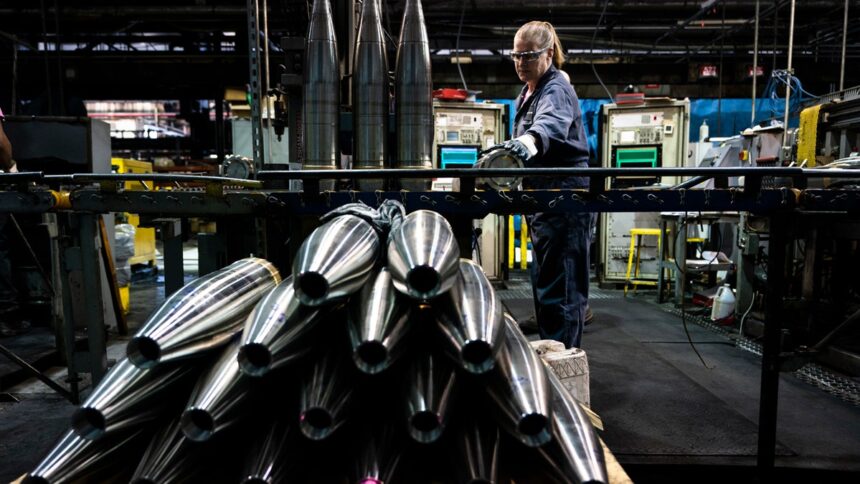
Recent conflicts offer sobering previews of how profoundly these disparities matter in wartime. In , U.S. and allied munitions production has struggled to keep pace with demand. For example, America ramped 155mm artillery shell output from about 14,000 per month to around 40,000, falling far short of Ukraines needs â estimated at 150,000â200,000 shells monthly â and exposing fragile, just-in-time supply chains. Similar constraints appear in meeting our own requirements and supporting Israel against Iranian-backed threats. Peacetime atrophy â dormant production lines, retired skilled workers, overseas dependence, and regulatory bottlenecks â has left the U.S. defense industrial base ill-equipped for sustained, high-intensity conflict.
History underscores the danger of underestimating industrial power. Nazi developed formidable new technologies during World War II: the Me 262 jet fighter, V-2 ballistic missiles, and advanced tanks. These “wonder weapons” stunned Allied forces when they appeared on the battlefield. Yet Americas overwhelming manufacturing juggernaut is what proved decisive. Mobilizing factories across the heartland, the United States produced nearly 300,000 aircraft, 86,000 tanks, and thousands of ships, vastly outproducing the Axis powers combined.
Similarly, in the Civil War, 90 percent of our manufacturing economy was in the North â which produced 20 times more pig iron and 32 times more firearms than the South â which was still primarily an agrarian economy. Perhaps more ominously is the lesson we can draw from the Norths embrace of mechanization, which allowed threshing to be done 12 times faster than slave labor. Todays corollary is Artificial Intelligence (AI) â the Great Power which dominates AI will gain the upper hand easily in any conflict, just like the North did, dominating the South which clung to the morally repugnant â but also ineffective â manual labor. Both mechanization and AI need reliable, dispatchable power to provide their economic and industrial benefits.
Today, China enjoys the advantage once held by America. Chinas defense industrial base and supporting infrastructure can much more easily shift to a wartime footing, surging output of ships, munitions, and material with little or no bureaucratic or legal constraints.
Reversing Americas defense industrial decline requires more than a tweak to an administrative process, increasing permitting staff, or changing deadlines for filing lawsu