A new State Department report argues that Cuba has cultivated a network of American activist organizations that can be mobilized against U.S. policy, citing a publicly posted plan for protests at U.S. military bases, Immigration and Customs Enforcement (ICE) facilities and federal buildings as a recent example.
The June “National Rapid Response Plan” was distributed by the National Network on Cuba, a U.S. coalition of more than 60 organizations. The State Department links the coalition to the Cuban government through its relationship with the Cuban Institute of Friendship with the Peoples, or ICAP, a government entity sanctioned in June for allegedly supporting Cuban intelligence activities.
The plan calls for “coordinated nationwide actions” within 24 hours of a U.S. military attack â or the “imminent threat” of one â and says its goal is to make it “politically and materially costly for the U.S. government to wage war on Cuba.”
The plan already has been made publicly available. The State Department report presents it as evidence of what it describes as a broader Cuban effort to cultivate and mobilize sympathetic organizations inside the U.S.
The National Network on Cuba’s “materials reveal the continuing reach, coordination and sophistication of Cubas subversive capabilities on American territory,” the State Department report claims.
TRUMP EXPANDS CUBA SANCTIONS BEYOND US COMPANIES IN MAJOR CRACKDOWN ON FOREIGN ENABLERS
The rapid-response plan calls for demonstrations and establishes a timeline for activating supporters nationwide. If U.S. military action begins before 3 p.m. Eastern time, demonstrations would start at 6 p.m. local time that day. If it begins later, activists would mobilize at 6 p.m. the following day.
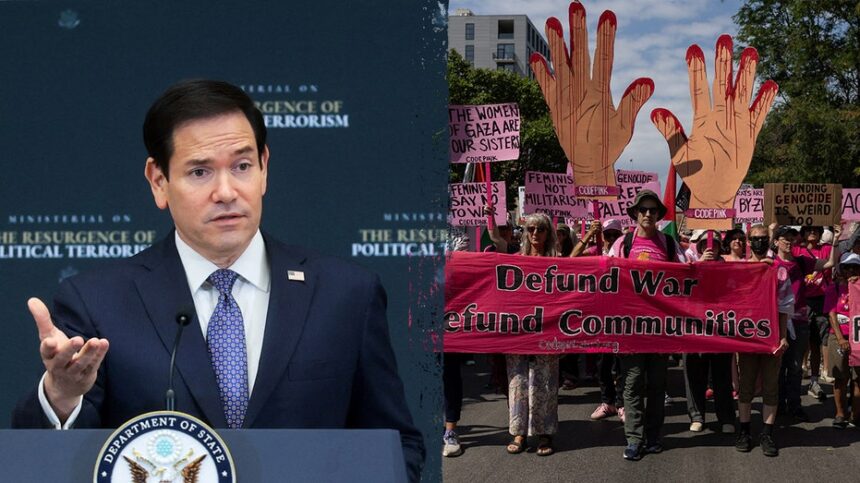
Organizers are instructed to gather at federal buildings, courthouses and post offices; military bases and recruiting offices; or ICE detention centers and field offices. The plan also lists sports arenas during high-profile events as optional locations.
The State Departments focus on the plan comes amid escalating U.S. pressure on Havana and discussion of possible military intervention or regime change. Trump has floated a “friendly takeover” of Cuba and, when asked in May about intervening, said “it looks like Ill be the one that does it.” Rubio has said the administration prefers diplomacy while leaving military action on the table.
The plan says demonstrations at immigration facilities would “connect Cuba solidarity to anti-ICE/immigrant defense work happening nationwide.”
It also directs activists to a Black Alliance for Peace database that the State Department report says maps 1,335 U.S. military and law-enforcement locations across the Western Hemisphere. The group describes the map as a basis for local organizing that can help activists “strategize how and where to organize and agitate.”
The National Network on Cuba openly promotes the plan on its website as part of its “No War on Cuba” campaign, alongside calls for rallies, banner drops, caravans, teach-ins and other demonstrations.
INSIDE CUBAS FOREIGN INFLUENCE CAMPAIGN: FROM THE ’60S VENCEREMOS BRIGADE TO A CALIFORNIA