

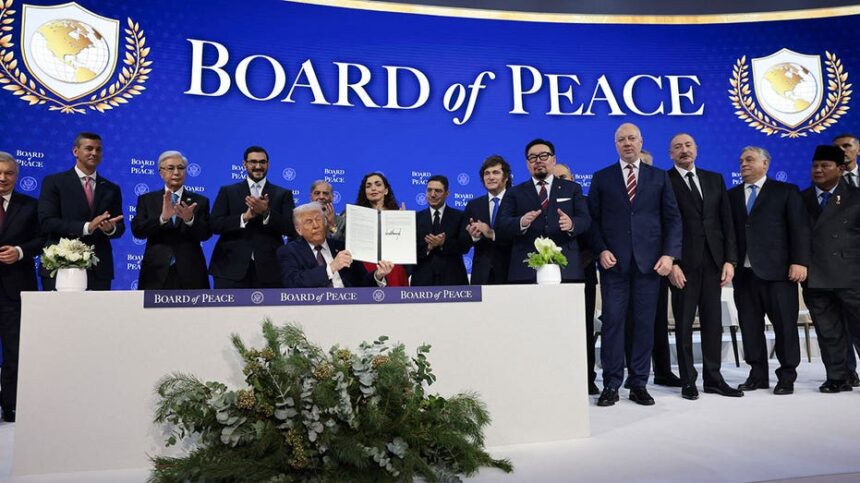
President s newly created Board of Peace is set to hold its first meeting Thursday, with administration officials and participating countries framing the gathering as a step toward implementing the next phase of the Gaza ceasefire and reconstruction effort rather than a moment likely to deliver an immediate breakthrough.
At least 20 countries are expected to attend the inaugural session in Washington, where Trump is slated to chair discussions on a multi-billion-dollar reconstruction framework, humanitarian coordination and the deployment of an international stabilization force.
at the World Economic Forum in Davos last month. Initial members include the United Arab Emirates, Saudi Arabia, Egypt, Qatar, Bahrain, Pakistan, Turkey, Israel, Hungary, Morocco, Kosovo, Albania, Bulgaria, Argentina, Paraguay, Kazakhstan, Mongolia, Uzbekistan, Indonesia and Vietnam.
On Sunday, Trump said members of the initiative had already rebuilding Gaza and would commit personnel to international stabilization and policing efforts. “The Board of Peace will prove to be the most consequential international body in history, and it is my honor to serve as its Chairman,” Trump wrote in a social media post announcing the commitments.
Italys foreign minister, Antonio Tajani, has announced a plan to train a future Gaza police force, while Indonesia has committed thousands of troops to a prospective international stabilization mission expected to deploy later this year.
The United Arab Emirates, a founding participant in the initiative, said it plans to continue its humanitarian engagement in Gaza.
“The UAE remains committed to scaling up its to support Palestinians in Gaza and to advancing a durable peace between Israelis and Palestinians,” the UAE Ministry of Foreign Affairs said in a statement, noting its role as a founding member of the Board of Peace and part of the Gaza Executive Board.
Even as Gulf and regional partners signal willingness to fund humanitarian needs, tied to security conditions on the ground.
Analysts say the meetings significance will hinge less on headline announcements and more on whether participants align on the unresolved core issue shaping Gazas future: .
Ghaith al-Omari, a senior fellow at the Washington Institute, argued the meetings credibility will depend on whether participants coalesce around a clear position on disarmament. “Unless there is going to be a joint statement coming out of it that clearly says Hamas has to disarm â to me the meeting would be a failure,” he said, because it would show “the U.S. cannot get everyone on the same page.”
Funding is also expected to dominate discussions, though diplomats and analysts caution that pledges may not translate quickly into large-scale reconstruction.
“Were going to see pledges,” al-Omari told Fox News Digital, “with a footnote that a pledge does not always translate to deliverables,” urging attention to which countries commit funds and whether the money is earmarked for humanitarian aid, stabilization or long-term rebuilding.
John Hannah, a senior fellow at the Jewish Institute for National Security of America (JINSA), also cautioned that early financial pledges are unlikely to translate into immediate large-scale reconstruction. “I cant imagine that much of that initial pledge or any of it is going to actual long-term or even medium-term reconstruction of Gaza. Just too many parties wont support it, pending actual progress on the core question of disarmament and demilitarization of Hamas,” he said.
Hannah added that the financing challenge remains enormous. “Its been a major outstanding question: How are you going to fund this tremendous bill that is going to come due over the course of the next several years?” he said. “Ive been watching this now for 35 years, and if I had $100 for every time a major Arab country pledged support for the Palestinians but not delivered, Id be a relatively we


